
Why We March: Pro-life Beyond Partisanship
-
 January 22, 2026
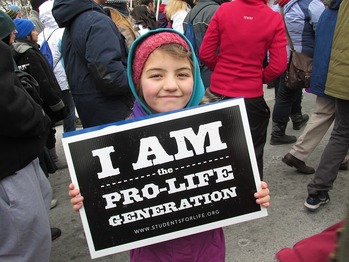
As the March for Life approaches, I find myself reflecting once again on what it means to be pro-life. At its core, of course, the pro-life movement is motivated by a simple conviction: human life is a gift that deserves to be protected, even in the womb. In a time when politics is often marked by extreme polarization, vindictive vitriol, and turbulent news cycles, it’s worth stepping back to reexamine why we march.
When I began participating in the annual march about twenty years ago, the purpose of the event was clear. We gathered each year on the anniversary of Roe v. Wade to work for the overturning of that Supreme Court decision. We marched to express our conviction that the Court had overstepped its role on January 22, 1973, manufacturing a right to abortion that is simply not found in the U.S. Constitution. The overturning of Roe v. Wade was the highest political priority of the pro-life movement in the United States for nearly five decades.
The pro-life landscape changed dramatically with the overturning of Roe v. Wade by Dobbs v. Jackson Women’s Health Organization on June 24, 2022. The Dobbs decision effectively returned the issue to the states, allowing state-level legislation to restrict or promote access to abortion. The response of state legislatures has been mixed: About 20 states have implemented new restrictions that would have been unconstitutional under Roe, while about 25—including Maryland—have protected or expanded access to abortion. In 2024, Maryland voters overwhelmingly approved a constitutional amendment enshrining a legal right to abortion.
You might expect that the number of abortions performed annually in the United States would have decreased, at least slightly, since the Dobbs decision. Instead, the opposite has occurred. Abortions per year in the United States steadily declined from 1990 to 2017 but have increased every year since, even as some states have instituted abortion bans.3 Abortion-inducing drugs such as mifepristone now account for a large and growing share of abortions, and women can currently access these drugs throughout the country through telehealth services without an in-person doctor’s visit.
The increase in abortions since Dobbs is a reminder that the success of the pro-life movement depends not only on changing legislation, but on changing culture. This is especially true in states like Maryland, where abortion access is now constitutionally cemented. As has been said many times over the years, we must work not just to change laws, but to change hearts. Pope St. John Paul II, in his pivotal encyclical Evangelium Vitae (The Gospel of Life), explained the Christian call to build a “culture of life”:
The Spirit becomes the new law which gives strength to believers and awakens in them a responsibility for sharing the gift of self and for accepting others, as a sharing in the boundless love of Jesus Christ himself. This new law also gives spirit and shape to the commandment “You shall not kill.” For the Christian it involves an absolute imperative to respect, love, and promote the life of every brother and sister, in accordance with the requirements of God’s bountiful love in Jesus Christ.
It is not only a personal but a social concern which we must all foster: a concern to make unconditional respect for human life the foundation of a renewed society. We are asked to love and honour the life of every man and woman and to work with perseverance and courage so that our time, marked by all too many signs of death, may at last witness the establishment of a new culture of life, the fruit of the culture of truth and of love.
As Pope St. John Paul II makes clear, a “culture of life” must be built upon a “culture of truth and of love.” In other words, we will become a culture in which life is valued and protected only if our society is shaped by the truth of human dignity and by genuine love for one another. People are more likely to welcome new life into a world marked by truth, charity, and hope.
As I reflect on the world around us, I can’t help but think that partisan politics is one of the main obstacles to building a culture of truth, love, and life. By 2016, the number of Americans who said they “hate” the opposing political party surpassed the number who said they “love” their own.1 The percentage of both Republicans and Democrats with a very unfavorable view of the opposing party more than tripled between 1994 and 2022.2 There is little doubt that partisan politics often motivates people not by truth and charity, but by tribal groupthink and hostility toward perceived enemies. Such spiteful and irrational partisanship—regardless of which “team” we support—builds a culture of death rather than a culture of life.
This brings me to the political elephant in the room. Over the past fifty years, the pro-life movement has formed an unofficial alliance with the Republican Party in order to advance legislation protecting the unborn. Donald Trump’s first term brought about a significant political victory with the appointment of several justices who contributed to the overturning of Roe v. Wade. Yet this legislative success has not come without a cultural cost. Republican politics in the Trump era has become more vindictive and tribal, often more focused on settling political scores and serving personal interests than on advancing truth or charity. The “compassionate conservatism” championed by Republicans in the early 2000s is largely forgotten.
At the same time, the Democratic Party has become increasingly inhospitable to life, leaving little room for those who are convinced that the unborn deserve legal protection. While the March for Life stage once included numerous pro-life Democrats, most have now been squeezed out of office, often through primary challenges backed by well-funded pro-abortion lobby groups. All in all, the American political landscape is now much farther from the culture of truth, love, and life that Pope St. John Paul II called for in 1995.
When I march each year, I do so because I dream of a culture in which life is truly respected and protected from conception to natural death. I march not to advance the partisan interests of any political party, but to advance the Gospel of Life. I march not because I hate political opponents, but because I long for a society in which the dignity of every human person—the unborn and the elderly, Democrats and Republicans, immigrants and those born here, the sick and the healthy—is honored and protected.
Endnotes
1 Columbia University Mailman School of Public Health, “Political Polarization Poses Health Risks,” https://www.publichealth.columbia.edu/news/political-polarization-poses-health-risks-new-analysis-concludes#/
2 Pew Research Center, “Rising Partisan Antipathy,” https://www.pewresearch.org/politics/2022/08/09/rising-partisan-antipathy-widening-party-gap-in-presidential-job-approval/
3 Kaiser Family Foundation (KFF), “Abortion Trends Before and After Dobbs,” https://www.kff.org/womens-health-policy/abortion-trends-before-and-after-dobbs