
A Human Went to Heaven & Sent Us the Spirit
-
 June 3, 2025
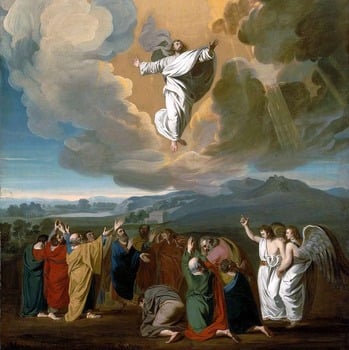
The Catholic Church this week stands between two of the most important feasts of the year: We've just celebrated the Ascension of our Lord – when Jesus was taken up into heavenly glory – and we are quickly approaching Pentecost Sunday – when Jesus sent the Holy Spirit upon the disciples. Understanding these two feasts is essential to understanding our lofty calling as Christians.
At the Ascension, a Human Took the Throne of Heaven
It s easy to misunderstand what happened at the Incarnation. Some imagine that the Son of God stopped being divine to come down from heaven as a human, then – after dying and rising again – stopped being human so he could return to heaven.
The reality is much more amazing. The Son of God, without ceasing to be divine, became a human like us. As a man, he died on the Cross for our sins and then was glorified in his Resurrection, so that his humanity was filled with the power of the Holy Spirit (CCC 646), fully sharing in his divine life. When he ascended into heaven, he did not cease being human but brought his resurrected body and soul into the glory of Heaven.
In the Resurrection and Ascension of Jesus, a human like us has passed beyond space and time into the glory of the Most Blessed Trinity and has been given God's authority over all of creation:
“Christ died and lived again, that he might be Lord both of the dead and of the living.” [Romans 14:9] Christ’s Ascension into heaven signifies his participation, in his humanity, in God’s power and authority. Jesus Christ is Lord: he possesses all power in heaven and on earth. He is “far above all rule and authority and power and dominion,” for the Father “has put all things under his feet.” [Ephesians 1:20-22] Christ is Lord of the cosmos and of history. In him human history and indeed all creation are “set forth” and transcendently fulfilled. [Ephesians 1:10; cf. Ephesians 4:10; 1 Corinthians 15:24, 27-28] (CCC 668, emphasis added).
Christ the Head Shares the Spirit with the Church, His Body
As Jesus ascended to heavenly glory, he pledged to send the promise of the Father, baptism in the Holy Spirit (Acts 1:4-5). Ten days later, on the feast of Pentecost, the Holy Spirit descended upon the disciples in tongues of fire, empowering them to speak the Gospel in languages that they did not know (Acts 2:1-13).
When St. Peter preached to the crowds to explain this gift of the Holy Spirit, he linked it to Jesus' Ascension:
God raised this Jesus; of this we are all witnesses. Exalted at the right hand of God, he received the promise of the holy Spirit from the Father and poured it forth, as you (both) see and hear (Acts 2:32-33).
Peter is saying, in effect, that Jesus fully received the Holy Spirit when he ascended to the right hand of the Father, and then he sent that same Spirit upon his followers. Although Jesus was anointed with the Spirit from the moment of his human conception, his humanity is now filled to overflowing with divine life, so that the Holy Spirit can pour forth upon all of us.
St. Paul makes a similar point: Jesus ascended to heaven and then “gave gifts to men” (Ephesians 4:8), distributing spiritual gifts from heaven to his Church on earth. Paul repeatedly affirms that Jesus is united to his Church as a head is united to its body, so we can already share in the life of heaven:
For in him dwells the whole fullness of the deity bodily, and you share in this fullness in him, who is the head of every principality and power (Colossians 2:9-10).
The Church's Mission is to extend Christ's Kingdom Until He Comes Again
At the heart of Jesus' preaching was the kingdom of God, the reign of God over his creation, which has broken into the world through Christ. Jesus ascended not to abandon the world, but to inaugurate his reign, and he sent the Holy Spirit to empower us to extend this kingdom on earth until he comes again.
Christians can easily fall into misunderstandings about the nature of this kingdom. One common error sees the kingdom as a merely human project, reducing the Church's work to promote social programs, political reform, and humanitarian aid. This outlook makes God an afterthought and overlooks that the kingdom is supernatural.
Another mistake sees the kingdom of God as something far away, as if salvation means escaping this material world to get to a purely spiritual heaven. This error implies that the kingdom has very little to do with the world in which we live right now.
The Gospel truth is that Christ's kingdom is present now to the extent that we allow Christ the Lord to reign in us through the Holy Spirit, and the kingdom will be present fully when Christ comes again in glory to judge the living and the dead, transforming the material universe itself to share in the glory of his resurrection.
The Church, the body of Christ on earth, is already the seed of that kingdom:
As Lord, Christ is also head of the Church, which is his Body. Taken up to heaven and glorified after he had thus fully accomplished his mission, Christ dwells on earth in his Church. The redemption is the source of the authority that Christ, by virtue of the Holy Spirit, exercises over the Church. The kingdom of Christ [is] already present in mystery, on earth, the seed and the beginning of the kingdom (Catechism of the Catholic Church 669).
Our mission is to live and proclaim the Gospel. By the power of the Holy Spirit, we are called to trust Jesus Christ as Lord in all of the details of our lives and to encourage others to do the same. Through this cooperation with the Holy Spirit, may we help to extend the kingdom of God on earth, until Jesus Christ comes again to fully bring it to fulfilment.